
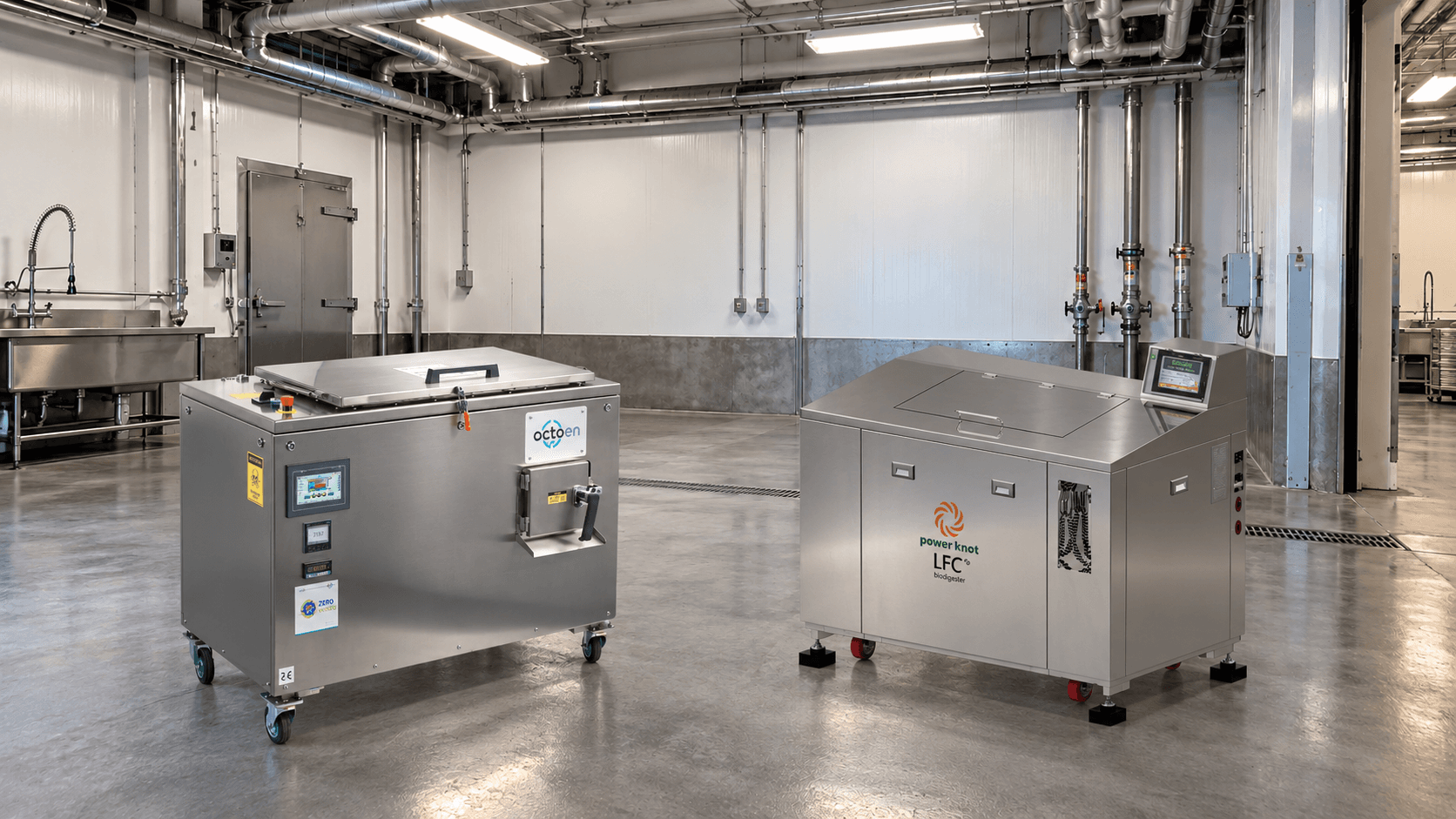
A composting machine and a food waste biodigester can both treat organic waste on-site, but they do not produce the same result. A commercial composting machine uses biological decomposition to create material intended for compost. By contrast, an LFC aerobic food waste digester breaks down suitable food scraps in a continuous process and produces a liquid effluent—not solid compost.
That difference affects space requirements, daily operations, the treatment times involved and what must happen to the material leaving the equipment. For hotels, restaurants, hospitals, catering facilities and food businesses, the right choice depends on the type and quantity of waste generated and the intended outcome.
What Is a Commercial Composting Machine?
A commercial or industrial composting machine is equipment designed to manage the biological decomposition of organic material under controlled conditions. In aerobic composting, microorganisms need an appropriate balance of oxygen, moisture, temperature and feedstock to break organic matter down.
The objective is to create compost: a stabilised organic material that can be used as a soil amendment when it meets the applicable quality requirements. Depending on the equipment and waste mix, material leaving the machine may still need a curing or maturation stage before it is ready for its intended use.
An industrial composting system may run in batches or continuously. Processing time varies with the technology, feedstock, system capacity and definition of finished compost; it should not be assumed that every machine delivers mature compost in a single short cycle.
Is an electric food waste dehydrator the same as a composter?
Not necessarily. Some products marketed as food waste recyclers or electric composters primarily grind, heat or dehydrate food scraps. They may reduce weight or volume without producing biologically stable compost. The distinction matters when comparing machines, specifying an output or making environmental claims.
Explore Lagain Ecosolutions' industrial composting machines for professional organic waste treatment and compost production.
What Is an Aerobic Food Waste Biodigester?
A biodigester is equipment that uses biological processes to break down organic matter. There are important differences between the two broad types:
- Aerobic biodigesters use oxygen. The Power Knot LFC systems offered by Lagain Ecosolutions are designed for continuous on-site food waste treatment and produce a liquid effluent.
- Anaerobic digesters work without oxygen and may produce biogas and digestate. They serve different technical and operational purposes and should not be confused with LFC units.
Inside an LFC food waste digester, microorganisms, water, oxygen and gentle mixing create the conditions for food waste to decompose. Food scraps can be added during the working day, subject to the model's daily capacity and operating instructions.
According to manufacturer Power Knot, LFC biodigesters can break down most compatible food waste within approximately 24 hours. This is a manufacturer performance statement, not a fixed cycle time for every ingredient or installation. High-fibre foods and different loading patterns can affect treatment speed.
The result is liquid effluent, not finished compost. Whether it can be discharged or must be handled in another way depends on its characteristics and the applicable wastewater rules and site permissions. A digester should not be presented as eliminating all waste management obligations.
Find out more about Lagain Ecosolutions' commercial food waste digesters.
Composting Machine vs. Biodigester: Main Differences
| Comparison | Industrial composting machine | LFC aerobic food waste biodigester |
|---|---|---|
| Main purpose | Produce material intended for compost | Treat food waste continuously at the point of generation |
| Biological process | Controlled aerobic composting | Controlled aerobic digestion |
| Output | Compost or composting material that may require curing | Liquid effluent; no solid compost product |
| Processing time | Varies by system; curing can add time | Manufacturer reports approximately 24 hours for most compatible foods |
| Loading | Batch or continuous, depending on the model | Continuous loading within rated capacity |
| Output management | Collection, possible maturation and compost use or distribution | Effluent handling in accordance with wastewater requirements |
| Site needs | Suitable space and operational arrangements for the composting process and output | Water, electricity, appropriate drainage and model-specific installation conditions |
| Typical objective | Organic waste recovery through compost | Reduce the storage and collection of compatible food scraps |
The key question is not which technology is universally better, but which output your facility can manage effectively. Both systems can form part of a commercial food waste management strategy, but their practical roles are different.
Which Food Waste Can Each System Process?
Waste compatibility must be checked for the exact equipment and operating conditions. Neither system should be assumed to accept every organic material.
Waste suitable for industrial composting
Depending on the equipment and the required recipe, commercial composting machines may process fruit and vegetable scraps, food preparation waste, bakery products and other compatible organic materials. Feedstock balance, moisture, contamination, aeration and the eventual compost use all affect the process. Certain food wastes need particular handling and process controls.
Waste suitable for an LFC food waste digester
The LFC range can process many common food scraps, including fruit, vegetables, bread, rice, pasta, cooked food, meat, fish and dairy, subject to the selected model's guidelines and restrictions. Different foods digest at different rates, and unsuitable items must be kept out of the machine.
For either technology, assessing the actual waste stream—not only a headline daily kilogram figure—is an essential first step.
Advantages and Limitations of Industrial Composting
A food waste composting machine may be a good match when your organisation wants to:
- Recover organic material in a form that can be put to beneficial use as compost.
- Support a composting or circular-economy programme with an identified destination for the output.
- Process compatible organic waste on-site rather than relying solely on external collections.
The organisation must still plan for output handling, process monitoring, possible curing, quality requirements and the staff and space needed for routine operation. Composting should not be described as an instant or maintenance-free solution.
Advantages and Limitations of Aerobic Food Waste Digesters
An aerobic food waste biodigester can be attractive when a facility needs:
- Continuous on-site treatment of food scraps during daily operations.
- Less temporary food waste storage, reducing the amount waiting in bins for removal.
- Potentially fewer external collections for the fraction of waste the equipment can process.
- Operational records and monitoring: compatible LFC configurations can record loading weights and provide reporting through LFC Cloud.
- No solid compost to mature or store, because the output is liquid.
A digester also has constraints. Equipment selection and installation need to account for water, electricity, drainage, maintenance, the types of food waste and the permitted management of effluent. Other waste streams will still need suitable disposal or recovery routes.
Which System Is Better for a Hotel, Restaurant or Commercial Kitchen?
The answer depends on the intended outcome, the nature of the waste stream and the facility's infrastructure.
Choose an industrial composting machine when your site wants to make compost and has a viable way to manage, cure and use or distribute it. This may be suitable for facilities with a broader organic waste recovery programme and space for the associated operations.
Consider an LFC aerobic biodigester when you generate food waste throughout the day and want to reduce the volume of scraps stored in collection bins. This is particularly relevant to busy restaurants, hotels, hospital kitchens, catering operations and central kitchens—provided the site is suitable for the equipment and an acceptable effluent management route is available.
Five questions to ask before choosing equipment
- How much waste is generated per day? Measure average volume, seasonal fluctuations and peak periods.
- What is in the waste? Identify the food types, packaging and materials that the equipment cannot accept.
- What should happen to the output? Establish a clear destination for compost or an approved management route for liquid effluent.
- What services and space are available? Review electricity, water, drainage, access, working area and staffing.
- What are the full operating costs? Compare equipment, installation, utilities, labour, maintenance and the remaining waste collection requirements.
A realistic commercial comparison requires site-specific information. Neither lower waste volumes nor lower disposal costs should be guaranteed without assessing the installation and local arrangements.

Composting Machines and Food Waste Digesters from Lagain Ecosolutions
At Lagain Ecosolutions, we work with both technologies because different businesses have different organic waste management goals.
If your priority is the production and recovery of compost, discover our industrial composting machine range. If you need continuous treatment of suitable food scraps at the point of generation, explore our LFC food waste biodigesters.
Not sure which system is right for your facility? Tell us what waste you generate, how many kilograms you handle each day and what space and services are available. We can help assess the appropriate technology, treatment capacity and installation requirements for your project.
Frequently Asked Questions About Composting Machines and Biodigesters
What is the difference between a composting machine and a biodigester?
An industrial composting machine processes organic matter to produce material intended for compost, which may need further curing. An LFC aerobic biodigester breaks down compatible food scraps in a continuous process and produces liquid effluent rather than solid compost.
Does an aerobic biodigester produce compost?
No. LFC aerobic biodigesters do not produce solid compost. Anaerobic digesters are a different technology and may produce biogas and digestate. Those outputs should not be confused with the effluent from an LFC system.
How long does an LFC food waste digester take?
Power Knot states that its LFC technology can break down most compatible food waste in approximately 24 hours. It is a continuous process, and results depend on the food types, loading rates and operating conditions.
Which is better for a restaurant: a commercial composter or a food waste digester?
A commercial composter can be appropriate if the restaurant has a viable destination for compost and can manage the process. An aerobic digester may suit restaurants looking to treat suitable scraps continuously and reduce bin storage, subject to site and wastewater requirements.
Can the liquid output from a food waste biodigester go down the drain?
Not automatically. The suitability of sewer discharge depends on effluent characteristics, local wastewater rules and any relevant permits or discharge consent. The proposed installation and discharge arrangements should be verified before equipment is commissioned.
Technical References
- US Environmental Protection Agency — Approaches to Composting. Composting methods, maturation and the distinction between compost and pre-processed food scraps.
- Power Knot — LFC Biodigester FAQ. Continuous operation, compatible foods, manufacturer processing claims and monitoring.
- Power Knot — LFC Biodigester. Overview of the LFC technology and model family.